NGI ENGINEROOM





Sources
Unique terms: 0+
Media articles: 0
Working papers: 0
Analysis period: two years and three months
Multiple gigabytes of raw
and processed data
Why ArXiv and SSRN?
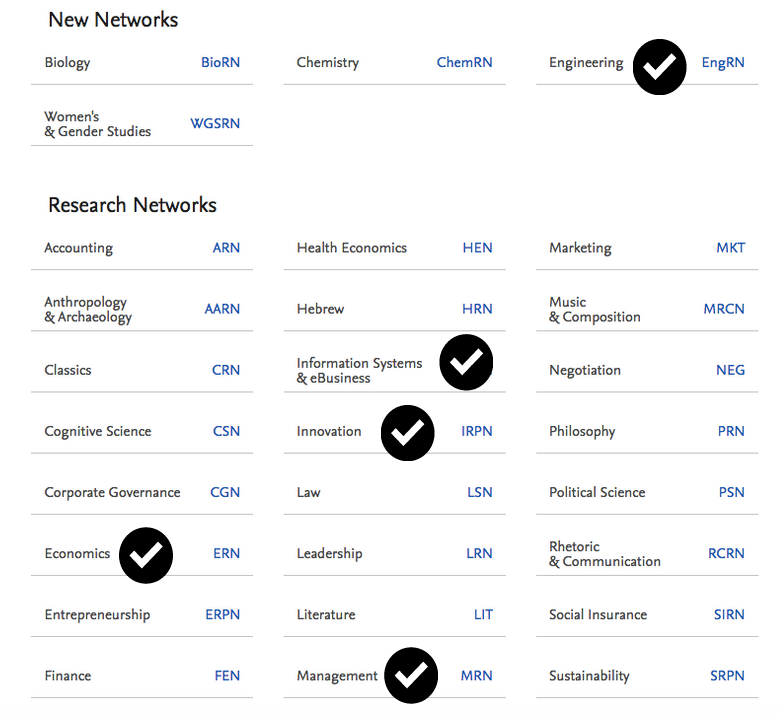
SSRN's e-Library provides almost 800,000 research papers from 365,000 researchers across 30 disciplines
ArXiv provides open access to almost 1,500,000 e-prints mostly in STEM fields
Methodology
Project Goal and General Idea
- Major aim is to identify key technologies determining the development of Internet until 2025
- Strong focus on the relationship between technological areas and social issues
- Data-driven approach with heterogeneous sources of data
Trend analysis
- Analysis based on the frequency of appearances for all unigrams and bigrams in the texts
- Average monthly change in the analised term's frequency is calculated by OLS regressions
- The coefficient reveals the trending unigrams and bigrams
Co-occurrence analysis
- Exploring the relationship between topics
- Pairs of terms which are mentioned together in media articles
- The number of articles containing both terms is divided by the number of articles including our previously identified keyword of interest for every media website
Issue mapping
- Articles are categorised across two dimensions: geography (EU vs US) and covered topic (social vs technological)
- Words are ranked based on their frequency in articles classified as social and non-social (technological)
Wikipedia network analysis
- Matching the keywords to Wikipedia articles and parsing their text to extract hyperlinks
- Generating the network of hyperlinks that connects the articles with one another
- Using a community detection algorithm (the Louvain method) to identify clusters of nodes
Main Programming Tools
Topic identification
132 most trending NGI related keywords are identified
Grouped into 21 wider areas
The size of the bubble is based on the regression coefficient
Bigger bubble: more robust trend
The size of the bubble is based on the regression coefficient
Bigger bubble: more robust trend
Topic co-occurrence
The goal is to dive deeper in emerging technologies
Relationship between social issues and technology
These pairs frequently appear together in articles (news) or are used in comments about a topic (reddit)
News co-occurrence
Reddit co-occurrence
News media
- The figure shows trending terms that frequently appear in articles with most relevant social issues
- Artificial intelligence and machine learning are key elements of discussion
- Work-related issues are strongly related to autonomous technologies and the gig economy
- Content crisis has major links with elections, the Cambridge Analytica scandal, operations attributed to Russian actors and the responsibility of tech giants
- Privacy issues are debated in the context of GDPR and online platforms
- To dive deeper, co-occurrence is examined in Reddit comments
- Reddit is an open, pseudonymous community, where emerging technology and related challenges are popular topics
- Different vocabulary, more detailed discussion
- The figure shows the terms that relatively more frequently appeared in Reddit comments than in news media articles
- Blue outline: not trending in online news
- Insight on emerging open-source programming tools (Scikitlearn-Python), hardware (Odroid) and privacy enablers (Duckduckgo)
- Polarizing discussions on social issues: e.g. gig economy and serfdom, future of cryptocurrencies (Beanie Babys)
Filtering process
- Most relevant, trending uni/bigrams related to social issues are selected for analysis
- The co-occurrence is calculated for word pairs consisting of these terms and the most trending 15000 bigrams
- For each social issue, a separate filtering has been carried out
- The terms are sorted by the index described in the methodology section, and 10 most relevant are picked from the first 30 words
- All raw results are available (The columns represent the social issues, while rows the trending words. Columns ending with count_freq_weighted contain the index used for sorting)
- Raw data: social issue unigrams
- Raw data: social issue bigrams
Short topic list
Click buttons to read short descriptions
|
Linked keywords: open internet, net neutrality, personal data, cambridge analytica, identity theft, black box, ai research
|
Linked keywords: hate speech, alt-right, extremist content, sexism, gender discrimination, #metoo, child safety, trafficking, parental control, youtube kids, diversity, racism, accessibility, 5G networks, care robots, voice assistants and chatbots, online safety |
Linked keywords: smart contracts, distributed ledgers, facial recognition, digital assistant, voice assistant |
|
Linked keywords: cybersecurity, ransomware, cyberwar, cyber threats, meltdown, nonpetya, hacking, quantum computing, encryption, critical infrastructure, autonomous weapons, killer robots, equifax |
Linked keywords: Machine learning, deep learning, algorithmic bias, algorithmic accountability, artificial intelligence, black box, open AI, data lakes, transparency |
Linked keywords: election hacking, election meddling, fake news, foreign intelligence, new media, filter bubble, echo chamber, media literacy, weaponisation of information, advertising, cambridge analytica, bots, fake accounts, platform economics, media platform, conspiracy theories |
|
Linked keywords: privacy, informed consent, smart cities, self-driving cars, facial recognition, surveillance, data brokers |
Linked keywords: open internet, net neutrality, free speech, internet freedom, gig economy, ico, worker's rights, tech giants, distributed ledgers, consumer protection |
Linked keywords: blockchain, cryptocurrency, smart devices, energy efficiency, mining, renewable energy, data storage |
 Internet
& Data Sovereignty
The Cambridge Analytica revelations have made it abundantly clear how little control we have as consumers over our own personal data, and the way the internet operates more generally. Building solutions and new models that allow citizens to understand the increasingly more complex processes behind dominant internet applications should therefore be a key component of a more democratic NGI. Experimentation with encrypted data boxes and data commons, as well as fostering more citizen involvement in, for example, internet governance processes and technology development would need to be a part of this, as would moving production of these technologies back into Europe.
 A Safe, Accessible
& Diverse Internet
Before we can talk about building a next generation internet, we need to ensure that all Europeans can have access to the current generation of the internet - that means investing in infrastructure, multilingual and accessible tools (targeting for example less tech savvy or lesser-abled users), but also creating a safe environment for all (particularly as online harassment and hostility particularly affect more vulnerable groups). Increasing diversity in who gets to build and use the internet is important if we want to ensure we don’t perpetuate existing inequalities also in the digital economy, but also helps stimulate innovation, as diverse teams tend to be more creative.

Online Identities & Trust
If Europe were able to build a trustworthy and secure system for managing online identities, offering an e-ID to every European citizen (not unlike the incredibly successful Estonian model), the continent would be able to take a massive leap ahead in strengthening e-commerce and other relationship-based online interactions. Effective identity management wouldn’t only increase trust on the internet (who am I really talking to? Can I trust the online service?) and so bolster the European digital economy, but would also help us build more personal online relationships. The currently dominant rate-and-review system places a lot of power in the hands of the reviewer (a single low score on ride sharing app can seriously damage a driver’s ability to attract new customers), e-identity systems could make these interactions more positive and equal.

Cybersecurity and Resilience
One key component of building a more democratic and inclusive Next Generation Internet is ensuring the infrastructures underpinning the internet itself are secure, safe and resilient. We live in a time of growing cyber threats: from rising cyber crime to ever more sophisticated cyber warfare capabilities. Existing weaknesses and flaws in the internet’s physical infrastructure and protocols also require urgent mending. Governments, the private sector and citizens need access to the right tools and information to help them protect themselves against these kinds of threats, and larger systems changes are required to ensure our (critical) infrastructures are resilient in the face of merging challenges such as quantum computing-enabled cracking of encryption.

Ethical AI & ML
As discussions about the potential transformative impact of AI and Machine Learning have come to dominate public debate in recent years, so have concerns about the potential negative side-effects of allowing these kinds of technologies to play an ever-larger role in decision-making and the governing of our societies. The development of ethical AI and ML tools doesn’t only involve the use of responsibly managed data (make sure we have a representative sample, privacy and anonymity is ensured) and algorithms that don’t further existing societal biases (around gender and ethnicity, for example), but also that the tools themselves are used for purposes we consider ethically just. Ensuring we have solutions that are fair and inclusive along the value chain (from data generation to the impact of the decisions being made or tasks replaced).

Trustworthy Online Media and Information Ecosystems
The proliferation of “fake news” and the weaponisation of information is a key challenge for the internet today, threatening the fundaments of our democracies and even societies. Ensuring access to trustworthy information, and preventing the deliberate manipulation of information flows without resorting to censorship and hampering of freedom of speech remains an unsolved challenge however. Under this topic, we would explore potential solutions for specific issues such as fake news bots and preventing filter bubbles, but also take a wider view in trying to strengthen (social) media ecosystems and exploring alternative sustainable business models for quality news and information provision.

The Right to Opt out & Self-Govern
With the internet becoming ever more pervasive in our lives and societies, shaping our jobs, our cities, our interactions with the government and so forth, it has become harder and harder for individuals to shape our relationships with, or opt out of “the internet” altogether. With the rise of the smart city, and the millions of connected IoT-devices that will underpin it tracking our every move, how do we ensure citizens can meaningfully consent to what happens with the data they generate, and retain their privacy? With everything from our smart vacuums to credit card companies collecting and selling our data to the highest bidder (through very opaque processes), we need new solutions that help citizens give informed consent, as well as the ability to completely opt out of being part of, for example, data sharing systems, while still being able to use key services.

Decentralising
Power
Most of the issues the internet faces today are a direct consequence of the increased monopolization of the internet, and the business models that sustain this dynamic- and when not, at the very least are more complicated to address because so few actors have the power to do so. We urgently require new business models that can provide an alternative to the reigning advertising-supported model, and can sustain a more pluralistic and healthy digital economy. Alternative models, such as platform cooperativism or blockchain-enabled micropayments systems can help empower smaller players, help level the playing field and offer better protections to consumers and digital workers. We need to support initiatives and SMEs that operate under these alternative models, through policy (protecting net neutrality, designing next generation competition and antitrust policy) and funding support.

A Sustainable
Internet
One key challenge for the internet moving forward is ensuring that the hardware and infrastructures underpinning it are sustainable and can meaningfully contribute to building a more circular economy. The challenges around the internet’s environmental footprint are myriad: from the extraordinary amount of energy used by data centres and emerging technologies like blockchain, to the costly mining processes behind the materials making our tech devices function. Though there is a growing recognition of these issues, we do not yet see enough solutions- this is we think a space where Europe can start to play an important front-runner role.
Issue mapping
Articles are classified in two dimensions: EU/US, social issue/technology
EU axis: articles from European sources or concerning Europe
Social issues axis: articles containing words from a pre-defined list of social topics
Mapping trending words with article type based on no. of occurrences
Top right corner: EU articles on social issues
Bottom left corner: US articles on technology
Charts
Application to explore trending keywords by source
Common terms: compare the trend of the keyword across sources
Trend robustness
Case study
Topic clusters around online privacy
Online privacy is a widely discussed issue within the academia. In order to identify main research topics we have done a quick topic modeling exercise. First we have web-scraped working papers related to online privacy from the perspective of Social Sciences: SSRN. On this dataset we have performed document clustering using tf-idf, multidimensional scaling, k-means and pyLDAvis.
The preliminary results:
SSRN topic clusters around online privacy
Wikipedia
Network of trending keywords (based on arXiv, SSRN and Techno Media)
Expanded Network of trending keywords (based on arXiv, SSRN and Techno Media)
Network around NGI related technologies
Network around NGI related social issues and values keywords
About
EU ENGINEROOM has received funding from the European Union's Horizon 2020 research and innovation programme under the Grant Agreement no 780643. The content of this website does not represent the opinion of the European Union, and the European Union is not responsible for any use that might be made of such content.